
History of OTEC
1930 article where Dr. Claude discussed his Cuban OTEC experiment
The concept of OTEC was developed by
Jacques D’Arsonval
in France in the 1880's, after an idea presented by
Jules Verne in his novel
Twenty Thousand Leagues Under the Sea
(published in 1869). His disciple, engineer and entrepreneur
Dr. Georges Claude,
who improved the air
liquefaction process, and invented
neon lighting, tested
the concept in a cold lake in Ougreé, Belgium, using the heated discharge from a
factory which provided a temperature differential similar to that required by
OTEC. Based on his success at Ougreé, Dr. Claude then built the first OTEC plant in
Matanzas, Cuba
in 1930. The plant was destroyed by a hurricane during initial testing, but did
operate for a few days. Some persons claim that Dr. Claude attained net power generation, but
this cannot be verified with available information.
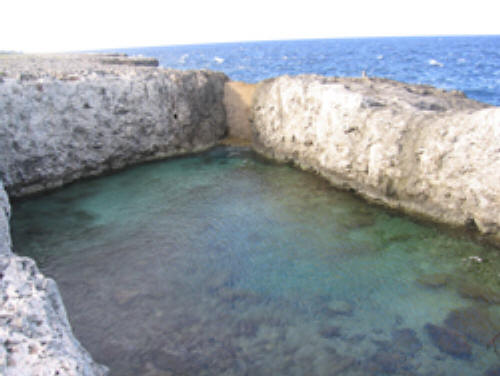
Part of the structures built by Dr. Claude in Matanzas, Cuba (from Cuban Bohemia)
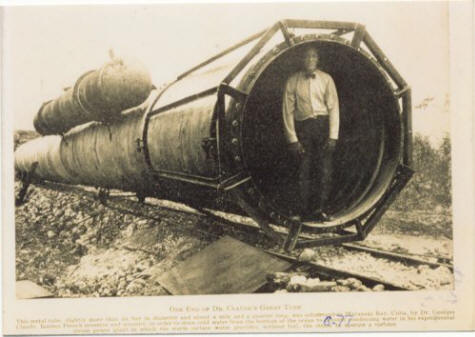
Cold water pipe used by Dr. Claude's team in Matanzas, Cuba
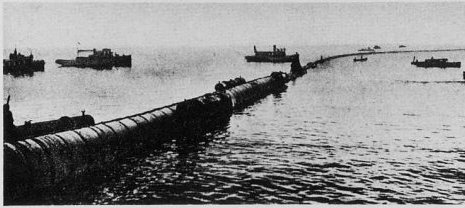
Installation of the cold water pipe by Dr. Claude's team in Matanzas, Cuba- a basic installation method for underwater pipelines still used today
Subsequently, and inspired by what he considered a success during his short-lived Cuban experiment, Dr. Claude attempted to use OTEC to manufacture ice in Brazil, but the facility was also damaged in a storm. In the mid 1950's French engineers again attempted to build an OTEC plant in Abidjan, Ivory Coast, but the plant proved too costly and was never built.
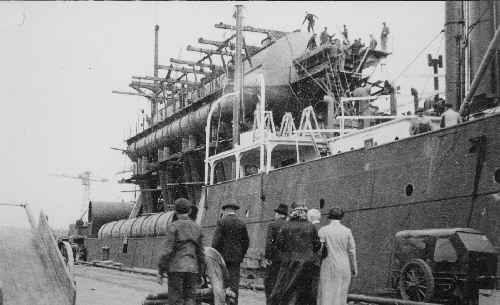
Ship "Tunisie", on which Dr. Claude installed his OTEC plant for Brazil (from French Wikipedia)
In 1950’s Norwegian-American engineer Bryn Beorse, who had studied the French work, and Professor Everett D. Howe founded the Sea Water Conversion Laboratory at University of California and obtained some government funds for research. An open-cycle plant was proposed for water desalination in California (the temperature differential needed to produce desalinated water is less than what is required to produce power) but government was not receptive.
During the energy crisis of the mid 1970's, interest in OTEC was renewed in the United States and elsewhere. The U.S. government launched various R&D programs that included performance tests, preliminary designs and demonstration plants. Major efforts include preliminary designs for OTEC production plants by the Applied Physics Laboratory of Johns Hopkins University, General Electric, and TRW Corporation; heat exchangers performance tests by the Argonne National Laboratory, and demonstration plants in Hawaii (Mini-OTEC and OTEC-1).
Other major R&D efforts during this period include the Toshiba/Tokyo Electric Power 100-kW closed cycle land-based plant at the Republic of Nauru, and the studies completed at the Natural Energy Laboratory of Hawaii (NELHA), which led to the construction and operation of a 210-kW open-cycle pilot plant for the co-production of electric power and potable water.
Proposals for 40 MW net demonstration systems were requested by the Department of Energy. The Puerto Rico Electric Power Authority (PREPA) was among the proposers and conducted several detailed studies on the feasibility of OTEC.
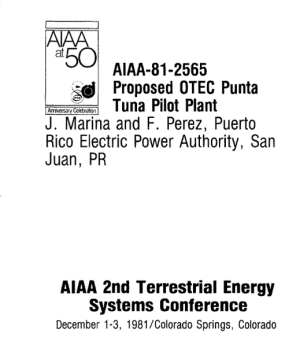
Paper presenting one of the proposals submitted by PREPA to the US Department of Energy
Later, when oil prices were reduced, the Federal government lost interest in the program, although the state of Hawaii has continued to investigate applications of deep ocean water. A Japanese consortium later built a land-based OTEC facility in the island of Nauru in the Pacific. However, both were research units too small to be scaled to commercial sized systems. India reportedly tested a 1 MW pilot plant.
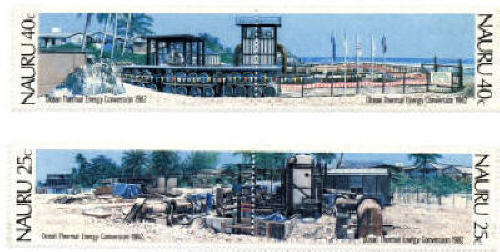
Conmemorative postal stamp showing the Japanese plant at Republic of Nauru, 1982. Plant provided valuable research and experience in cost-effective manner.
To learn more about why research in OTEC stopped, and why OTEC is desirable today, click on the links below:
More Information and Copies of Articles and Presentations
Presentación Especial en Yabucoa (in Spanish)
(c) 2012 Offshore Infrastructure Associates, Inc.